
Urban Service Robots: What Cities Deploy and Why
Street-cleaning robots reach $6.2bn by 2034, driven by labour shortage, not technology. What Guangzhou and Hangzhou did, and how one night corridor starts.
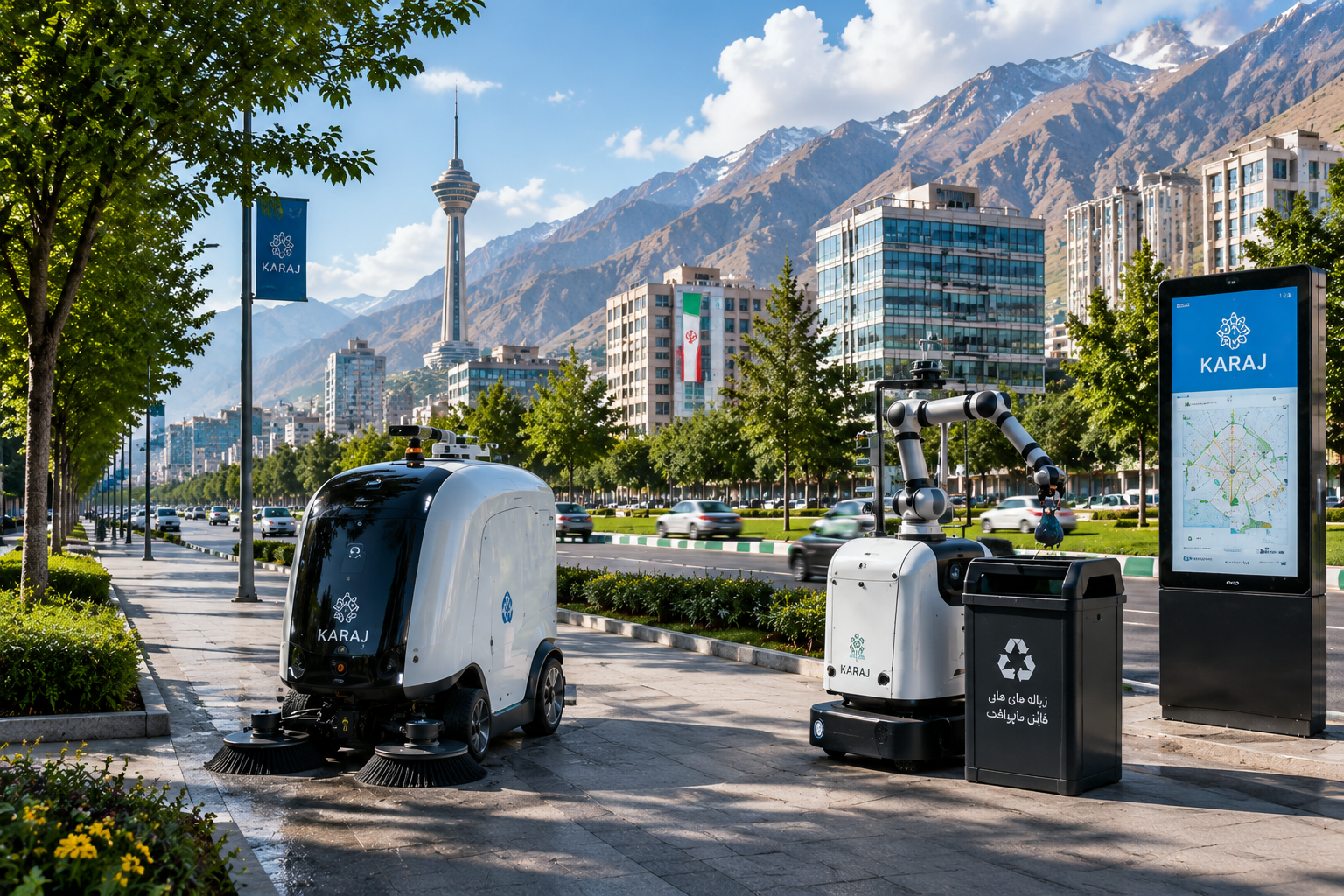
The street-cleaning robot market grew from 1.8 billion dollars in 2025 and is projected to reach 6.2 billion by 2034 — a compound annual rate of 14.2 percent. The driver behind that growth is not what most people assume.
It is a labour shortage, not enthusiasm for technology. Cities struggle to recruit and retain sanitation staff because the conditions are demanding and much of the work happens overnight. Robots take on precisely the shift that is hardest to staff.
What cities are actually doing
Three deployments that have moved past the pilot stage:
- Guangzhou plans to raise its fleet of unmanned cleaning units to 1,000 during 2026.
- Hangzhou went further and now requires unmanned equipment to be included in new public sanitation tenders — the step from experiment to procurement policy.
- Porvoo, Finland runs a fully electric autonomous sweeper that cleans streets and paved areas mainly at night.
In an adjacent category, Serve Robotics has deployed more than 2,000 sidewalk delivery robots across US cities.
Why night cleaning is the logical entry point
The common pattern is not accidental. Night work has three properties that suit automation:
Traffic is light. The robot faces a simpler environment and the risk of interacting with pedestrians and vehicles drops sharply.
Night shifts are the hardest to staff. Automation returns the most exactly where the shortage is worst.
The result is visible the next morning. Unlike many technology projects, this one produces an output you can see and measure.
What this means for a city like Karaj
Karaj has characteristics that suit such a project: long, well-defined main corridors, heavy daytime traffic, and a street network that empties overnight.
A realistic starting point:
One corridor, not the whole city. A single main boulevard of defined length whose current cleaning standard can be measured.
The night shift. Between one and five in the morning, when traffic is at its lowest.
A numeric measure defined in advance. Area covered per hour, energy consumed, and the person-hours freed.
Complementing staff rather than replacing them. The robot takes the repetitive straight-line work; people handle the places that need judgement — under benches, along kerbs, irregular spaces.
Three things to settle before starting
Charging and maintenance. A robot needs a charging station and a service schedule. That is a running cost, not a one-off.
Liability. If the robot strikes an obstacle or is damaged, who answers for it? Settle that in the contract before deployment, not after.
Public acceptance. The robot operates in shared space and people will encounter it. Experience elsewhere shows that telling residents beforehand makes a substantial difference to how it is received.
Frequently asked questions
Do cleaning robots replace human workers?
In the cities that have deployed them, no. The common pattern is a division of labour: the robot takes repetitive straight routes while people handle complex spaces requiring judgement. The driver has been a shortage of staff, not a surplus.
What does a project like this cost?
It depends on scope. A pilot on one corridor with one machine is a fundamentally different order of cost from a citywide programme. International experience consistently shows that narrow scope has the best odds of reaching real operation.
Do these robots work in rain or snow?
That varies by model and should be asked before selection. Some are built for varied weather and some are not. It is one of the key questions in evaluating a supplier.
Where should a city begin?
By measuring the current state. Without a baseline — area currently covered, person-hours spent, cost per kilometre — there is no way to prove the project achieved anything.
The short version
Urban service robots are no longer experimental. When a city like Hangzhou writes them into its tender requirements, the proof-of-concept stage is over.
The logical starting point is one corridor and one night shift, with a measure defined in advance. That path fits a limited budget and produces a result within months.
The same narrow-scope logic applies across urban infrastructure; AI traffic management and AI leak detection are two examples. For how this data eventually fits into a single city model, see urban digital twins.
Related services from Qatreh
Qatreh is based at the Alborz Science and Technology Park in Karaj and works with organisations across:
- Computer vision and robotics — image processing, autonomous navigation and monitoring systems
- AI consulting for business — defining the pilot scope and the measurement metric
- AI training courses and AI consulting for education — building capability in the operating team
- Data science and predictive models for route planning and maintenance
- AI automation and citizen-facing chatbots
If you want to know which corridor would return the most from a project like this, talk to us.
Sources
- Smart Cities World — autonomous sweeper deployment in Porvoo
- Street cleaning robots market report, 2025–2034
- Industry reporting on Guangzhou's fleet plan and Hangzhou's tender requirement
- Serve Robotics — sidewalk fleet deployment report