
Smart Greenhouses: Predictive Control, Not Reactive
Predictive greenhouse control cut control-system energy use by over 55 percent in one study. Its real prerequisite is data, not technology. A guide to starting.
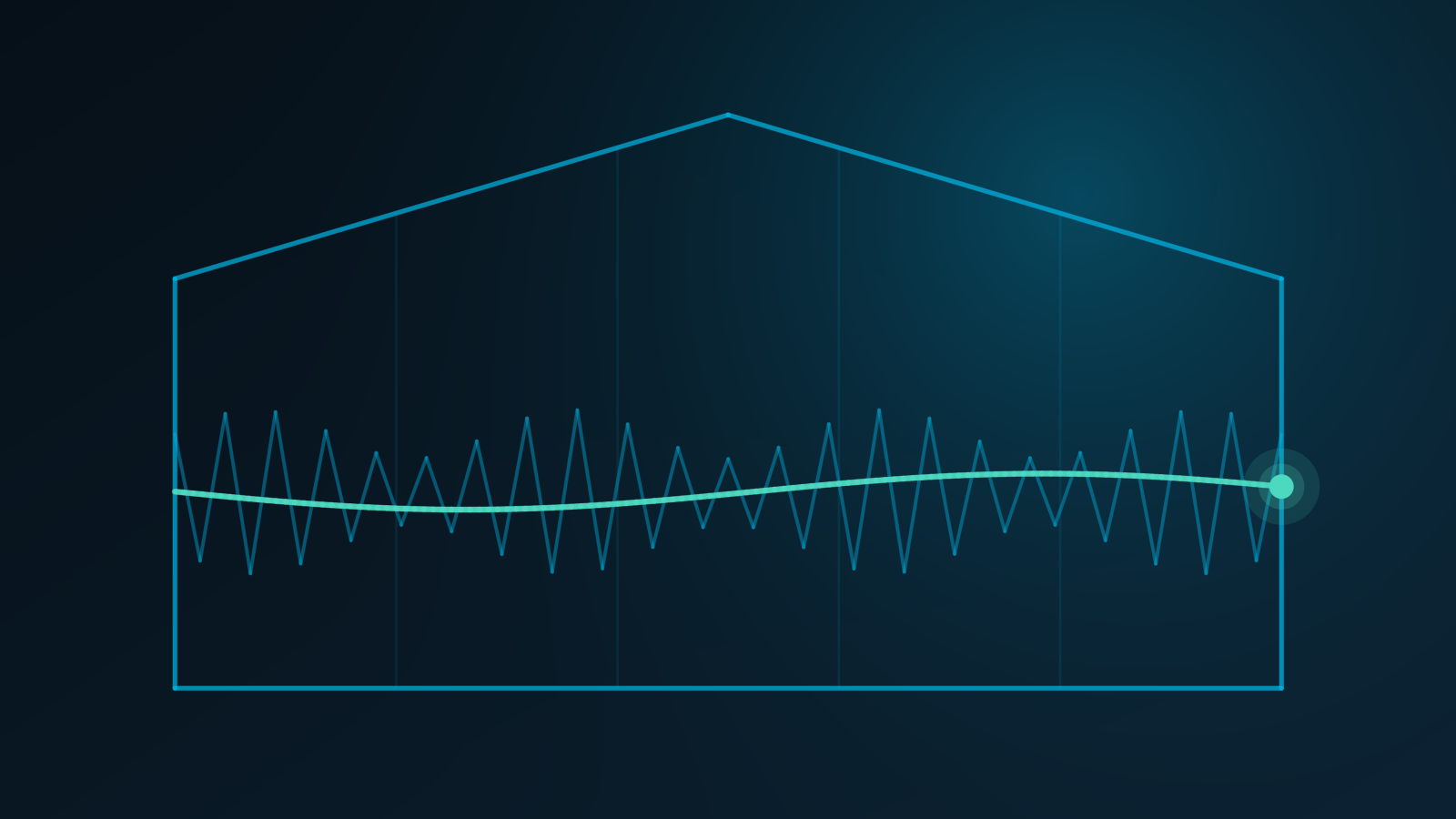
A greenhouse is an unusual environment in that almost everything about it is controllable: temperature, humidity, ventilation, light and carbon dioxide concentration. Unlike open-field cultivation, the variables are in the operator's hands.
But that controllability hides a problem. These variables are usually set with a thermostat and a timer: if the temperature passes this threshold, the fan runs; if it falls, the heater does. That logic works, but it is always reactive — it acts after conditions have already left the desired range, and the cost of bringing conditions back is always higher than the cost of holding them there.
That is the difference intelligent control makes: forecasting instead of reacting.
The figure that shows the difference
Research testing a deep reinforcement learning controller with robust optimisation in a semi-closed greenhouse reported over 55 percent reduction in the energy consumption associated with control systems.
That does not mean total greenhouse energy use halves; it means the portion spent switching control equipment on and off falls appreciably. The distinction between those two readings matters and is often blurred in marketing material.
The basis for such control is accurate forecasting. A study combining two gradient-boosted tree algorithms achieved a coefficient of determination of 0.9972 for temperature and 0.9976 for humidity in predicting internal greenhouse conditions. The model explains nearly all the variation in those two variables and can estimate the next hour's state with very small error.
When the future state can be predicted that precisely, ventilation can be raised gently before the temperature reaches its adjustment threshold — rather than the fan starting at full power after the desirable range has already been left.
Why forecasting is cheaper than reacting
Three practical reasons:
- Equipment runs at its efficient point. A fan cycling between full power and off consumes more than a fan running steadily at partial load.
- Temperature swings shrink. Plants are sensitive to fluctuation; a more stable environment usually yields better.
- Equipment wears more slowly. Frequent switching imposes most of the wear on motors and valves.
What the studies say less often
An honest point that appears in the same research and deserves weight: intelligent control requires a dependable dataset and computational resources.
So if a greenhouse today has no sensors, or its data is not recorded and retained, the project does not start with a model. It starts with recording data. A model with no history has nothing to learn from, and six months of logging is usually an unavoidable prerequisite.
This is the principle set out on our AI automation page: a project starts from one specific process and one numerical measure, not from buying technology. We explain the same condition in precision irrigation and image-based disease detection.
Which greenhouses is this worth for?
The honest answer: not all of them.
For a small greenhouse with one simple crop and a thin margin, the cost of sensors, modelling and maintenance usually is not justified. It is worth it where at least one of these holds:
- Large growing area, where a small percentage saving becomes a large number
- A high-value crop, where a few percent of yield improvement is a significant sum
- High energy use for heating or cooling, forming a major share of operating cost
- Several greenhouse units, where one model can serve them all
If none of those applies, the right answer is that it is not needed yet — and that is what we say.
For greenhouse operations in Karaj and Alborz province there is one practical advantage: sensor installation, calibration and periodic inspection all need someone on site. Working with a team based in the same province turns each of those from a trip into a visit. The general context for these services is set out in AI in Karaj.
A roadmap
Step one: record data before anything else
Install temperature, humidity and, where possible, CO₂ sensors, and log continuously. Without several months of history, modelling is meaningless.
Step two: set the metric and the baseline
Establish what is to improve: energy use per square metre, temperature stability, or yield. And record its current value.
Step three: build the forecasting model
The model first only predicts, and its predictions are compared against reality. Handing it control before its accuracy is demonstrated is a risk.
Step four: control with a human in the loop
The model proposes adjustments and the operator applies them. As trust builds, the level of automation rises. The reverse order is where projects run into trouble.
Step five: build internal capability
Greenhouse conditions change with crop and season, and the model must be retrained. An AI training course matched to the team, with an AI consultant for education, makes that possible. The full framework is described in enterprise AI training.
Step six: evaluate and decide
Compare the metric against the baseline after a full growing cycle. Expand only on demonstrated results.
Frequently asked questions
How does intelligent greenhouse control differ from a thermostat?
A thermostat is reactive: it acts after conditions have left the desired range. Intelligent control predicts the coming hours and makes gradual adjustments before that threshold is reached, which is both cheaper and produces less fluctuation.
What savings have been reported?
Research on a semi-closed greenhouse reported over 55 percent reduction in the energy consumed by control systems. That figure concerns the control portion, not total greenhouse consumption, and must be measured separately in each operation.
How accurate is the prediction of internal conditions?
In a study combining two gradient-boosted tree algorithms, coefficients of determination of 0.9972 for temperature and 0.9976 for humidity were reported — the model explains nearly all the variation in those variables.
What is the prerequisite for starting?
Data. Sensors and continuous logging, usually with at least several months of history. A greenhouse with no historical data should start by recording it, not by modelling.
Is it worth it for every greenhouse?
No. The economics usually work when the growing area is large, the crop high-value, energy use high, or there is more than one unit. For a small greenhouse with a simple crop, the cost is usually not justified.
Related Qatreh services
- AI automation for predictive climate control and applying settings automatically
- Data science for modelling greenhouse behaviour and analysing consumption
- AI consulting for business to assess the economics before any spending
- Computer vision for monitoring plant growth and health alongside sensor data
- Chatbot services for relaying status and notifications to the operator
- Robotics and automated systems in greenhouse operations
- AI training course for the technical teams of agricultural operations
- AI consultant for education to design the internal team's learning path
Qatreh is based at Alborz Science and Technology Park and offers these services as a complement to organisations' existing programmes.
Sources
- Energy-efficient AI-based Control of Semi-closed Greenhouses Leveraging Robust Optimization in Deep Reinforcement Learning — ScienceDirect
- Multi-Sensor Monitoring, Intelligent Control, and Data Processing for Smart Greenhouse Environment Management — PMC
- Smart greenhouse farming: a review towards near zero energy consumption — Discover Cities, Springer